Meeting Point und Nachbarschaftsversammlung

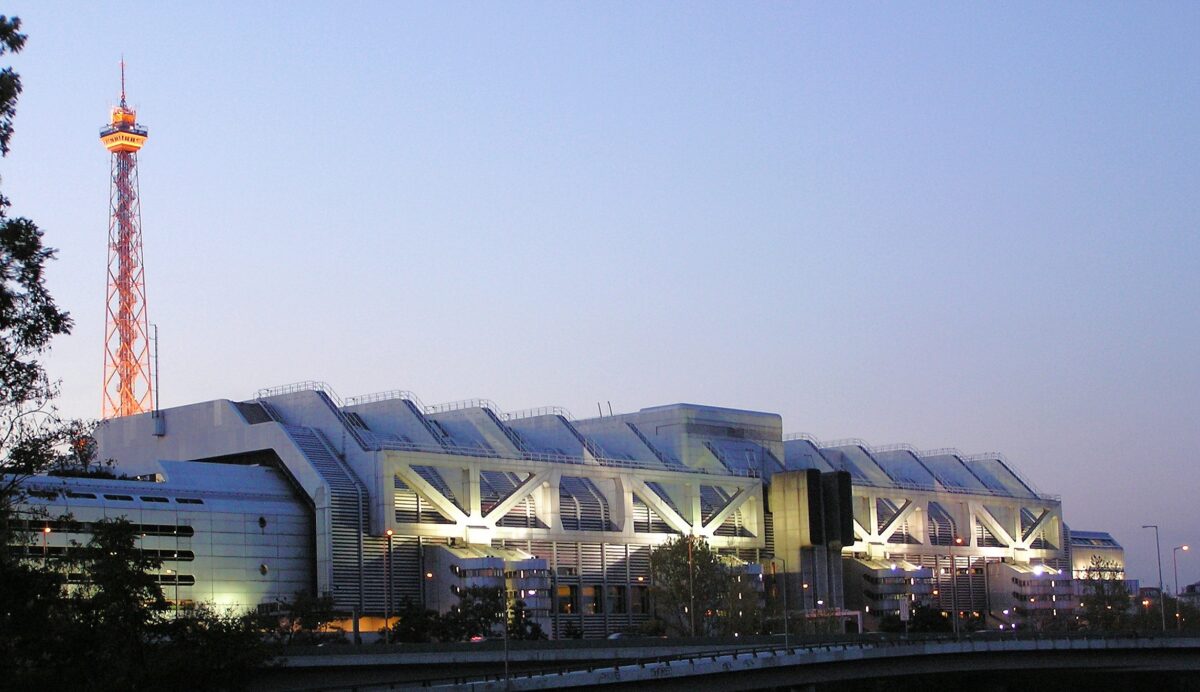
Das Internationale Congress Centrum Berlin, es steht leer. Im Jahr 2014 wurde es geschlossen, wegen Asbest, und anscheinend bevor es irgendeine Sanierung gab, wurde es 2019 unter Denkmalschutz gestellt (bin mir nicht sicher, ob das also auch für den Asbest gilt, der dort meines Verständnis noch vorhanden). Und nun redet man in Berlin über Pläne zur Weiternutzung, und aber eher unwahrscheinlich, dass da jemand mit ziemlichem Batzen an Geld zu finden ist, um diese Sanierung durchzuführen, die meinem Verständnis nach seit 2014 aussteht, weil man sich dann doch nicht sicher war, ob man es nicht abreißt, bzw. keine Knete vorhanden, mit Bau von Flughafen BER, usw.

Dazu erstmal zu dem Denkmalschutz – allgemein finde ich das eine gute Sache. Aber für mich ist da eher relevant, wie alt das Gebäude ist, und ob es halt wie ein Denkmal, wie der Kölner Dom, oder z.B. ein U-Bahnhof (wie Hermannplatz). Und wenn also z.B. der Mäusebunker derzeit unter Denkmalschutz steht, weil es “ein Meilenstein in der Geschichte des Brutalismus darstellt”, da hat das zwar was für sich. Aber ich finde es absurd, dass damit also Sanierungskosten, und ggf. Betriebskosten erhöht, für etwas aus dem Jahr 1981 (wenn man mal von Weiterbetrieb ausgehen würde, statt es 3D zu kartografieren und abzureißen). Und meinen Verständnis nach, haben sich die Bauweisen über die Jahrzehnte schon etwas geändert. Und wenn man allgemein erwartet, dass sich jemand finden muss, der spezifisch z.B. den U-Bahnhofbau der 1920er studiert hat, und dies um so zu bauen, mit ggf. auch Material, das so nicht unbedingt alles dieser Tage vorzufinden ist… das hört sich nach ziemlichem Hürdenlauf an, nur für ein paar Dinge, wie ein Eingang von U-Hermannplatz, der lange Zeit geschlossen. Dementsprechend würde ich beim ICC aus den 1970ern nicht groß über Denkmalschutz reden.

Und was die Nutzung betrifft, ich selbst gehe erstmal von Nutzung aus, weil selbst wenn man es also abreißen würde, den Asbest müsste man sowieso beseitigen, und eben professionell, und nicht einfach alles auf offenen Anhänger, und dann an Kitas mit vorbeifahren, u.ä.

Und meine Vorstellung ist, es als Meeting Point der hier lebenden Nationalitäten zu nutzen, als Anhang zur Versammlung der Vertretungen aller in Preußen lebenden Nationalitäten.


Zur Veranschaulichung, derzeit leben in Berlin, etwas mehr als 20.000 Bürger der USA. Für diese und auch weitere Nationalitäten dabei nicht großes Unterfangen, Wahlen abzuhalten, z.B. in digitaler Form und/oder mit Briefwahl. Und die Vorstellung, dass sich jede Gruppe Vertretung für die genannte Nachbarschaftsversammlung wählt, und man gemeinsam bissel chillt, und sich über verschiedenes unterhalten kann.

Die Vertretungen würde dabei Büros gestellt bekommen, und so. Sowie die Möglichkeit, sich einen der 80 Säle und Räume im ICC zu reservieren. D.h. für Veranstaltungen, wie z.B. Diskussionsrunde zur Zollpolitik der USA, zwischen den U.S. Bürgern und ggf. geladenem Gast, und mit Videoaufnahme (was technisch idealerweise gleich einheitlich fürs ganze Haus geklärt, dass das professionell vorhanden, ohne Notwendigkeit sich da auf Handy zu verlassen). Oder auch Pressekonferenz, oder wie auch immer in dem Veranstaltungssinne.

Ob das dann so viel genutzt werden würde, ist dabei natürlich separate Frage. Aber an erster Stelle hat man (mal) so ein Angebot, und damit kann schon mehr gemacht werden, als wenn es solches Angebot nicht gibt – insbesondere was diejenigen betrifft, die nicht groß über Mittel verfügen, um sich im Hotel Konferenzraum zu mieten, u.ä. Und wenn dann Räume leer stehen würden, da kann man noch Dinge machen, wie z.B. dass ein Raum wie bei Tagesschau usw. eingerichtet, und dort Journalisten-im-Exil TV-Newsdesk haben, oder z.B. einer der Räume für “eSports Veranstaltung” hergerichtet, also sowas wie bei LAN-Party.

Dabei auch Kantine oder so, dass an erster Stelle die Vertretungen auch gesamte Tageskonferenz planen können, mit einfach vor Ort Verpflegung geklärt, und somit das ganze weit gemütlicher.
Frachtverkehr und City-Güterbahnhöfe

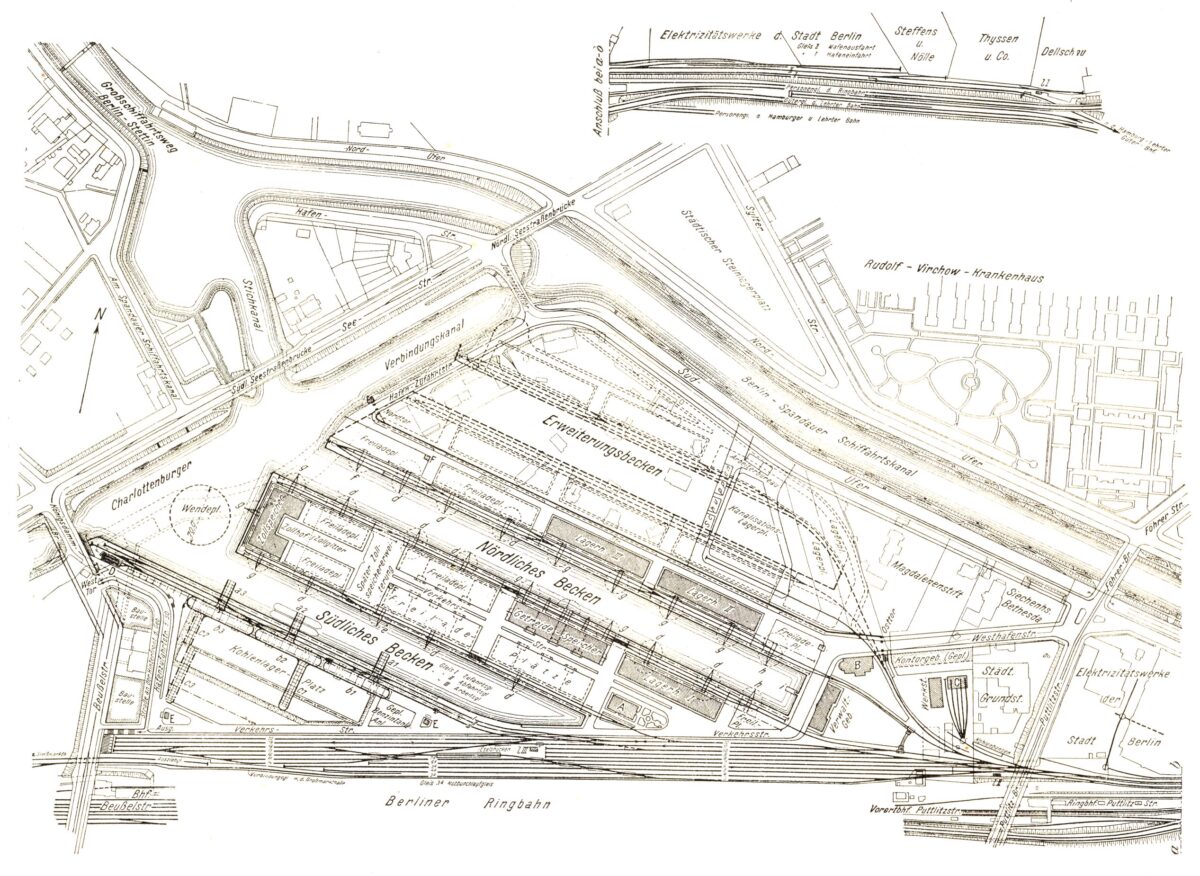
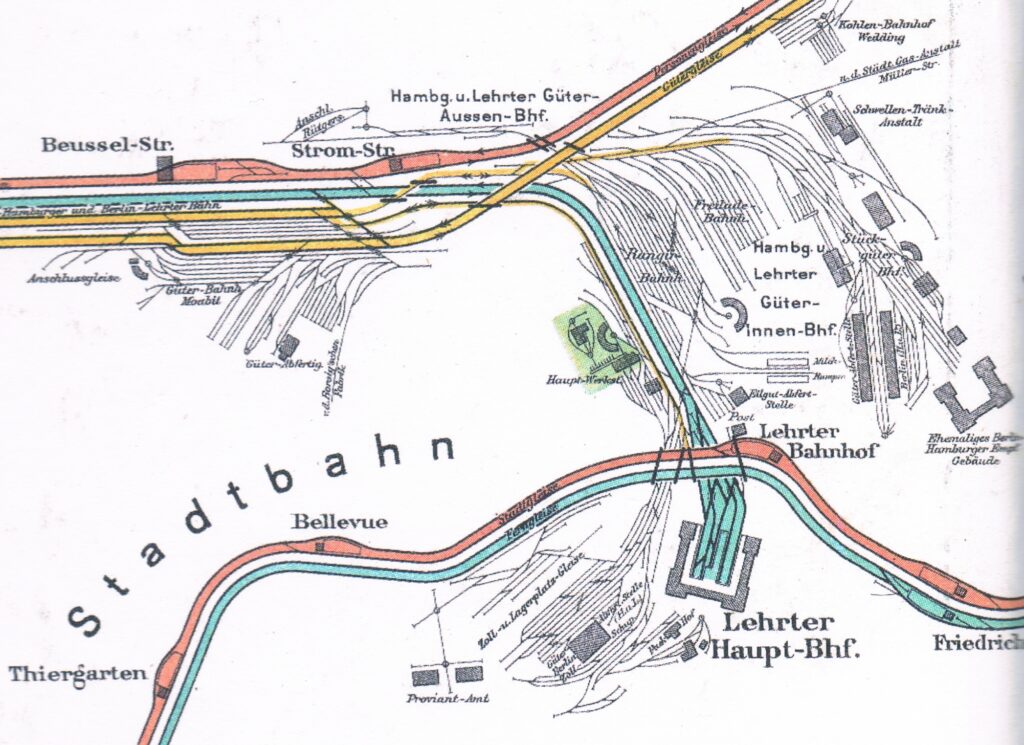
Im Bild oben zu sehen, der Lageplan des Berliner Westhafens, aus dem Jahr 1923.

In Berlin ist die Binnenschifffahrt, ein großer Teil der Stadtgeschichte. Siehe zum Beispiel, dass der erste Verbindungskanal zwischen Oder und Spree im 17. Jahrhundert eingeweiht wurde, als die Einwohnanzahl von so erstem Stadtgebiet Berlins an die 50.000 Seelen war. Anfang des 19. Jahrhunderts waren es so um die 172.988. Und das stieg dann relativ rasant an, mit mehr als Million an Einwohnern im Jahr 1878, nur was den damaligen Kern des seit 1920 vergrößerten Stadtgebiets darstellt. Und 1925 waren es mehr als 4 Millionen Einwohner, auf dem Stadtgebiet, wie man es auch heute noch kennt.

Mit der Industrialisierung im 19. Jahrhunderts kam es auch zur Nutzung der Bahn als Transportmittel. Hierzulande wurde das sehr gepflegt, mit technologischen Generationen an Lokomotiven, usw. Und entsprechend sah das dann, und teils auch heute noch, so aus, wie dem Bild oben.

Und dazu gab es separat noch, in unmittelbarer Nähe, Güterbahnhof, wie in diesem Bild von 1896 zu sehen. Dort wurde auch, direkt vom Bahnwagen auf Straßenwagen (oder andersrum) geladen.


Direkt nachbauen würde ich es so nicht, u.a. weil das Gebiet dieser Tage anderweitig bebaut ist. Aber so vom Konzept, im Kontext von Logistik und Stadtversorgung, finde ich es schon tolle Sache, wenn eine Frachtladung sogar im Stadtzentrum in Empfang nehmen kann, oder auch senden kann. Dies betrifft auf Bauvorhaben. Also, warum groß Dutzende LKWs mit Bauteilen Hunderte Kilometer, und dann noch durch den gesamten Stadtverkehr, entsenden, wenn es mit einem Zug geliefert sein kann, und dies so, dass das auf Abstellgleis auch Weile stehen kann, wenn die Bahnwagen nicht dringend anders benötigt, bzw. für kleine Gebühr Fläche dafür.

Dementsprechend meine ich, dass es schon angebracht wäre, mindestens einen Güterbahnhof wieder nach Berlin zu bringen – den ich als “City-Güterbahnhof” bezeichne. D.h., ein solcher Bahnhof dient vorrangig der Versorgung mit Kleingütern, wie z.B. Paletten oder Container für Supermärkte und so manches weiteres.

Im Unterschied zu Güterbahnhof auf dem Land, der sich etwas Platz nehmen kann, um vielerlei Dinge abzudecken, ist beim City-Güterbahnhof jedoch gewisse Kompaktheit gefragt. An diesem Punkt kommen die Postzüge ins Spiel, von denen ich zuvor redete, mit dem also staatlich entwickeltem (oder beauftragtem) Konzept der wie Schnelllogistik, um Tonnen an Fracht vom Zug auf den Bahnsteig, und andersrum, zu bekommen. Denn, wenn man sowas hat, dann kann man nämlich auch nur einfache Lade/Entlade-Rampen entlang bestehender Strecken planen.

Als Beispiel, der Abschnitt zwischen Spandau und Beusselstraße. An Charlottenburger Ch dort, wäre locker Platz für Bahnsteig. Und Frachtzug, liefert ab, und dann haben die umliegenden Betriebe es dort, und holen es sich z.B. mit Transporter ab. Oder auch z.B. mit wie auf den Flugplätzen, die das Zugfahrzeug beim Gepäck, wenn es zum Flugzeug gebracht wird. Nur halt mit Paletten hinten dran, oder so. Oder lokale Spedition beauftragt.

Teils könnte man da auch gleich schauen, ob man das auch für U-Bahn hinbekommt. Also als Prototyp, erneut Postzug. Und entlang der üblichen Strecke Bucht, wo es entladen wird, und dann irgendwie hochgehievt, oder per Servicetunnel, wenn da großer Betriebe nur paar Meter weiter liegt, wo man z.B. auch sowas wie Laufband, oder einfach nur wie Paketen die Laufrollen, legen kann, so, dass es vielleicht sogar direkt vom Zug von selbst in das Lager des Betriebs rollt.


Und was man damit hätte, ist einfach die Option für alle Betriebe in der Stadt, sich etwas z.B. aus Gewerbegebiet bei Rathenow zu bestellen, was in Größe von Palette aufwärts geliefert wird, und in relativer Nähe zum Betrieb ziemlich flott bereit steht. Oder auch, wenn der Betrieb selbst etwas in dem Umfang versenden möchte, praktisch wenn man es als Betrieb im eigenen Zeitfenster zur Abholung abstellen kann, und es dann per Güterzug dort ankommt, wo es hin soll.

Die Post als solche, würde da solche Infrastruktur auf jeden Fall für die Logistik von Paketen nutzen. Die Idee halt, die Masse an einzelnen Transportern, die in Anwohnerstraßen unterwegs sind, um etwas zu liefern, was oft nicht geliefert wird, weil der Empfänger nicht zuhause ist – diesen Straßenverkehr zu reduzieren. Dabei gibt es zwar schon diese Paketautomaten, die bei der Thematik helfen. Aber die Vorstellung wie derzeit, dass sich jeder Versandhandel die Gegend mit zig solcher Paketautomatenstationen zupflastern kann, wo derzeit hier in der Gegend schon der aus USA, und dazu also im Namen von gleichem Anspruch, wo Bezirk nicht sagen kann, dass OTTO aber nicht darf, oder Zalando, oder wie sie alle heißen – das finde ich absurd. Und für die Zustellung eines Pakets mit Großwagen in Anwohnerstraße zu fahren, finde ich auch absurd. Dementsprechend bin ich da viel eher ein Fan davon, dass sich so ein Versandhandel seine Paletten an Paketen für eine Nachbarschaft per Bahn sendet, und diese Pakete dann entweder in Poststelle zum Abholen, oder von dem Versandhandel selbst gekümmert, dass dieses Pakete z.B. mit elektrischem Lastenrad oder Kleintransporter verteilt werden.

Sozialpolitik, im Detail zu Obdachlosigkeit

Für Personen, die im Wohlstand aufgewachsen sind und nichts anderes außer dem Wohlstand kennen, mag der Begriff “Sozialpolitik” vielleicht ziemlich fremd klingen, oder sogar als etwas, wovon manche als Belastung reden, weil all die angeblichen Spitzenmanager doch so abhängig von Subventionen sind, und da ggf. sogar mit Lobbyverbänden für die Mittel aus dem Haushalt “konkurrieren”.

Für viele Leute ist “Sozialpolitik” aber so ziemlich der einzige Lebensfaden, den man so hat, weil man sonst nichts hat. Und wenn eine Sozialpolitik Mängel aufweist, dann ist das argumentativ an Dingen zu sehen, wie z.B. in Berlin, Tausende an unfreiwilligen Obdachlosen, die größtenteils von hier sind. Und dazu kommt noch eine Ziffer an Wohnungslosen, die bei Bekannten hausen – womit zumindest wie Standbein haben, um sich Job zu finden, um somit eher eine eigene Mietwohnung finden. Aber Arbeitsmarkt in Berlin, ungefähr zehnmal so viele Arbeitslose, im Vergleich zur Anzahl der ausgeschriebenen Arbeitsstellen.


Ich selbst rede oft im Kontext eines politischen Systems, wo der Staat, neben dem Parlament, eine separate Entität darstellt. Das Parlament als solches, ist oftmals mehroderweniger ein Zusammenschluss privater Interessen, bzw. Interessen wie der Arbeitgeber und der Gewerkschaften. Der Staat als solcher, den interessiert aber eher, ob es denn allen Leuten im Land gut geht – und falls nicht, da gibt es Dinge wie den Notruf, um z.B. eine schlimme Räuberbande dingfest zu machen, oder bei medizinischem Notfall zu helfen.

Und in dem Sinne ist es ja toll für die Leute, wenn es Hilfe auch bei weiterem gibt. Also zum Beispiel eine Situation in derzeitiger gesetzlicher Lage in Berlin, wo jemand obdachlos wurde, nach einer Eigenbedarfskündigung durch jemanden, der neu nach Berlin zuzieht. Die nun obdachlose Person hat dadurch vielleicht auch Job verloren. Und nun gibt es zwar Anlaufstellen, wie z.B. das Jobcenter, um Grundsicherung überwiesen zu bekommen. Aber da hört es schon ziemlich auf, mit dem, wie es weitergeht, mit sogar wie Catch-22, dass man also Job braucht um eher Wohnung zu finden, und aber ohne Wohnung sich kaum auf Jobsuche begeben kann.

Dabei kann sich die Person zwar an das Sozialamt wenden. Aber, wenn überhaupt was verfügbar ist, dann ist das oft ein Platz in einer Sammelunterkunft. Ich selbst hatte vor mehr als Jahrzehnt Glück, dass es Zimmer in einer Pension gab, und hatte von der Unterkunft aus, Job und dann auch Wohnung gefunden. Aber heutzutage sind das mittlerweile wie ganze Barracken, die manche private Firma damit betreibt, und wo selbst ein Hostel als noch vernünftig im Vergleich dasteht. Und solche Wohnbedingungen sind nicht gut genug.


Dementsprechend, auch wenn ich “Sozialpolitik” als eher Angelegenheit des Parlaments sehe, kommissarisch betrachtet, würde ich sagen, dass die Anzahl der Arbeitsstellen in den Sozialämtern erhöht wird. Diese Stellen dabei mehroderweniger mit Personal von freien Trägern besetzt – also, mit neuem Arbeitsvertrag, und bekannte Themenfelder.

Und dann ist die Idee, dass je Sozialamt, Zuständigkeit für Bezirk oder Landkreis hat, und in dieser Zuständigkeit auch für diejenigen zuständig, die ihre letzte Meldeadresse in dem Bezirk oder Landkreis hatten. Das bedeutet, der Fall von vorhin, die obdachlose Person beim Sozialamt, hier wäre ja ideal, wenn eine Wohnung direkt vermittelt werden könnte.

Um das zu erzielen, könnte man den landeseigenen Wohnbaugesellschaften sagen, dass Kontingent an freien Wohnungen vorzubehalten haben, und das diese Wohnungen über das Sozialamt vermittelt werden. Und dazu könnte man sagen zum einen, dass die Jobcenter-Leistung für Miete direkt überwiesen wird, und auch, dass das Sozialamt den Fall erstmal selbst übernimmt, was den Leistungsbezug betrifft, während der Kunde dann mit Wohnung und ausgeschlafen, aber zum Jobcenter wegen Jobsuche kommt.

Das mag sich soweit schick anhören. Aber große Hürde ist, dass nicht einfach so mal Tausende an Wohnungen verfügbar sind. Was man aber schon angehen kann, ist denn überhaupt zu ermitteln, wie groß der Bedarf denn wo ist. Lies, Sozialämter sollten Listen führen, derer die sich insb. als komplett obdachlos gemeldet haben – und anhand dessen, wäre ziemlich genau zu sehen, wie viele Wohnungen mehr, wo gebraucht werden.

Dieses Konzept würde ich dabei auch der EU vorstellen, damit man im Rahmen von Schengen ganz einfach sagen kann, dass wenn jemand aus Paris oder Warschau in Berlin aus dem Zug oder Bus steigt, und dies komplett mittellos, dass es für die Person ein zuständiges Sozialamt gibt, und man die Person zur Botschaft bringen kann bzw. den Weg erklären kann, wenn z.B. beim Sozialamt wegen was zu Wohnen nachfragen kommt, oder weil sich im Bahnhof Zelt aufstellen wollte, u.ä.

Damit wäre dann der Stand der Dinge, dass alle Einwohner vernünftiges Dach über dem Kopf haben, sowie Zugang zu Lebensmitteln. Dazu gibt es dann noch weitere Themenfelder, wie z.B. Pflegeheime. Aber auch deswegen, wären mehr Stellen bei den Sozialämtern praktisch – um da etwas Zahlenerfassung für die Politik zu machen (anhand welcher sehen können, dass wenn 1.000 Millionäre nach Berlin in Altbau ziehen, es entsprechend genauso viele Familien betreffen kann, in Obdachlosigkeit um Hilfe zu bitten) – und allgemein als Kundenbetreuer/in.

Expats, and the German language

Reportedly, there have been cases, where English-speaking expats living in Berlin for years, got dissed for not speaking German.

Underlying to this sort of diss, seems to be the notion, that one should learn the language of the country one resides in.

Personally, I lived and worked in three countries, with three different languages, I all learned to speak. But I generally wouldn’t expect it of every foreigner in Berlin. In example, tourists. I worked in hotels (in three different countries), and from my experience, a hotel e.g. in Spain employing staff speaking also German, and restaurants offering a menu also in German, they may likely have more revenue from tourists than a hotel, where the management is like: “No room for everyone, who can not recite Romance sonámbulo (surrealistic poem by Federico García Lorca) in Spanish.”

And then there is perhaps a 80-year old granny from Ukraine in Berlin. At that age, some persons are still fit enough to learn a new language. But to generally expect it, would be weird. Which then opens a bit different topic, in particular how to ensure that the granny can receive proper medical attention (beyond emergency per se), when she speaks only Ukrainian and just about every (licensed to practice) doctor in the city doesn’t. But there are options, such as having translator service, where staff translates remotely – that is, the granny doesn’t have to bring her own translator, but doctor uses PC or simply phone with loudspeaker to have a translator join the meeting.

Then there may be war orphans, who have arrived as minors on their own at the border. In such a case, it sure is nice if they get kind of adopted, as e.g. Germany does, by saying who their legal guardian is, and taking them to school etc. But, I am not sure if it is ok in such a case, to straight away basically “germanize” the minor, as in teaching it German, with no single lesson with their mother tongue. And that also isn’t a case, where I could plausibly agree with a general notion of “They have to learn German!”. Depending on the circumstances, if it is e.g. a Polish-speaking minor, contacting the Polish authorities about it, would seem a way more appropriate thing to do, than to “ethnically reeducate” the minor. And if the minor happens to be indeed a war orphan, well, to me it seems plausible for the child to have a teacher speaking their mother tongue, such as in form of a boarding school. At such school, the child may then also learn a new language, such as the local one. But to me that isn’t a primary concern.

Like, when a 16-year old arrives, who once had dreams about studying before their country was torn apart by war, there is no reason why the 16-year old couldn’t finish their highschool classes in their mother tongue – and if there is a prospect for them to then study in perhaps yet another country, or in a field that heavily relies on English anyhow, well, then English lessons would sound primarily important for the 16-year old, to boost the study path, and then also job opportunities.

That also brings me to international students in general. Like, when someone arrives in Berlin to study for 5 years, not necessarily in German, but i.e. computer science in English. Sure nice if they learn at least a few phrases in German. But generally, they are likely busy with their study. As is everyone in Berlin for a work-stay.

And as far as I see it, there is no problem at large, when not everyone in the city speaks the same language with each other. There are cases, where it sure is even practical to speak one common language. I.e. when a family is in Berlin with child in school, it sure is nice when also parent and teacher can understand each other. But generally, when e.g. David Bowie, Iggy Pop, and Nick Cave lived in Berlin, it wasn’t like the world would have necessarily gained much, if they would have happened to start singing German Schlager-music, in the name of integration into the one German society.

The fear of immigration

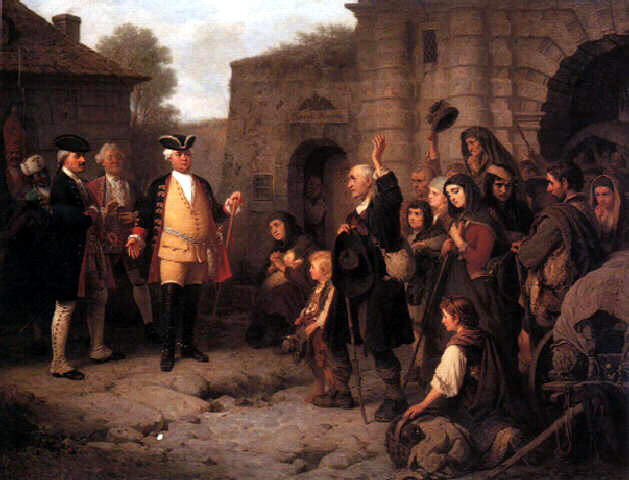
“King Frederick William I of Prussia welcomes the Salzburg Protestants, 30th April 1732”
– Painting by Konstantin Johann Franz Cretius

White rural America is very afraid, of being replaced by something else. At least a prominent Republican implied so, all while the same side associates crimes with immigrants to such an extent, that mass-deportations are supposed to solve it all. And what would the folks living their entire lives in villages and small towns know about it, when they are told by supposedly informed authorities, that foreigners are coming to get the girls – with cases, such as that Virginia Giuffre did indeed end up marrying a foreigner, after old-ish white Americans had their fun with her.

Personally, I do see things way more differentiated. In example, over here in Europe, there are sometimes violent confrontations between hooligan-fans of soccer-teams. So, when there is a soccer match, and hooligans from one town commit criminal acts in another town, i.e. 50 miles away, that could also be considered a sort of migrant criminality. Yet, to erect a wall between the two towns, that doesn’t really help about there being on both sides males, who want to be violent.

And historically, here in Berlin, there hasn’t been any problem with immigrants at large, until Nazis arrived and claimed that there is a problem. Berlin grew to a city with millions of inhabitants, by 1920 one of the largest world-wide, due to immigration from near and far. And quite a number of these were refugees.

In particular, in the year 1685, there was the Edict of Potsdam, after which approximately 20,000 Huguenot refugees settled in Prussia. Huguenots had been persecuted in France.

By 1731, many of the 20,000 Salzburg Protestants, settled in Prussia, after having been expelled due to the Counter-Reformation. Similarly, also Protestants from other places arrived, and refugees from Russia, and also folks e.g. from Turkey – in particular serving in the Prussian Army, see “Bosniak Corps” from the mid-18th century, and also i.e. diplomats, like Ali Aziz Efendi, who died in 1798 and had funeral according to Islamic rite in Berlin – and by mid-19th century, the Ottoman Empire had a plot of land in Berlin, that is since used as cemetery (now by Turkey).

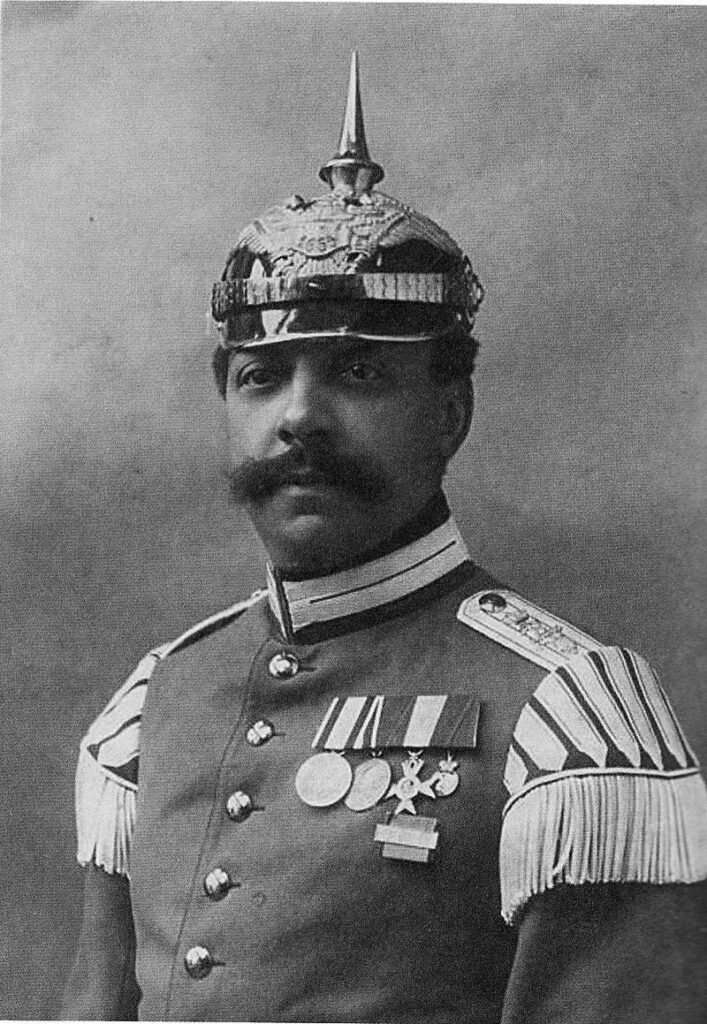
And quite a number of other stories. I.e. in this picture here, Gustav Sabac el Cher in 1908, born 1868 in Berlin. He served as bandmaster in the Prussian Army.

So, to say, as some do, such as among AfD, or similarly the White House, that immigration is generally a bad thing, such notion seems quite absurd to me.

And, especially when there is humanitarian catastrophe, these days mostly man-made, it isn’t the refugees that are to blame. In example, Syria – permanent UN Security Council members seem to have fought a proxy-war over there, with also fanatics from Iraq involved – and then someone born in 2005 turned up at the border from Syria, and gets blamed for everything bad? That seems quite a ridiculous notion.

And as far as criminality by foreigners is concerned, there is also a lot to differentiate. Like, the homeless person from Poland, who somehow ended up in Berlin, and got caught stealing food or something to drink from a shop, such “simple theft” represents about 20% of all crime in Germany – and then it even differentiates further, in regard to that about a quarter of shop thefts are attributed to persons working there, and another quarter to gang criminality as such. And the homeless from abroad, when someone actually takes a look, they can see that these persons sit like in a ditch between the national Social security systems of EU member states. Like, no income whatsoever, and no local health insurance – pretty much existential poverty.

In this case, these persons may perhaps once have had a slim chance of not becoming homeless. But a wall on the border to Poland doesn’t help these people, who would likely just end up sitting in a homeless camp elsewhere, when politics in several countries are just like: “It’s everyone for themselves! Hundreds of billions in monthly profits of U.S. companies, and no dime even for our own homeless.”.

And stuff like that, where at least some humanism would be nice instead.

Politically motivated – What does that mean?

Today, Tuesday, in Berlin, part of the city experienced a power outage, affecting about 50,000 households. Power won’t be restored for many of them, until Wednesday or even Thursday.

This was due to a fire damaging a power line, at 3:30 AM. Police suspect “politically motivated arson”.

“politically motivated” – this term may not be familiar to many. E.g. in the UK, they went to talking about terrorism already after some group painted an airplane, after they easily got into an supposedly secure area this plane was at.

So, please allow me to try to explain, what this term means.

In example, let’s take my political stance about road safety. I am a fan of individual mobility, but also a fan of people making it back to their loved ones, after venturing outside. In Berlin in 2024, this wasn’t the case for 55 persons, who died due to traffic accidents, with about half of them having been on foot.

I may even have got as far, as writing elaborate essays, such as about improved design of road intersections, and as far as speeches, such as:

“Why, people, why? Real life isn’t supposed to be like Hunger Games etcetera. Let’s stop this sort of social-darwinist lottery of death, in which every week someone gets killed (on average). And let’s instead improve public matters for everyone!”

But, to no avail for real improvement. CDU and SPD even announced another cut to the budget for pedestrian safety, bringing it to about 3 million Euro, which is apparently the entire budget per year, for improving e.g. pedestrian crossings, from a city budget of about 40 billion Euro.

And now to the hypothetical, let’s say I am all mad about it, that people are just a statistic to them people in charge, who drive around in their limousines. And with such rage about these things, I go out at night and slash the tires of cars, perhaps in some misguided notion of that such action will wake the people up, and perhaps even make them stand against this system, that cares so little about fundamental rights of humans, such as the right to life, to begin with.

But, once caught, I would get charged, for what is considered a crime. And, it wouldn’t be nice to the people affected, some of who may be working for little money i.e. as nurse, confronted in the morning with not being able to get to work by car, and having quite some hassle to get it fixed. And it would produce a lot of unnecessary waste.

And in such context, what local police would talk about, is a crime, that was politically motivated.

Not sure, where exactly such case would show up in the police statistics of “politically motivated crime”, where the categories are “right extremism, left extremism, and Islamist extremism”. But generally speaking, it seems a more reasonable approach to talk about these matters, than to consider a trespass already a terroristic act, due to which an entire group was proscribed as terrorist by the House of Commons on 2 July 2025.

Malicious intent – The basics

The particularities of whether the term “malicious intent” exists in some form in a number of law systems around the globe, and if so, what does it entail, for something to be considered malicious intent, and how it is applied and weighted, that does vary among jurisdictions and courts of law. The context also matters. For example, in a criminal court case, a judge, jury and/or tribunal, may care little to not at all, about whether a person accused of severe rape, had intent or not, to do harm, as the harm has been proven to have been done. So, please be aware, that I may not be talking about the exact kind of “malicious intent”, as someone elsewhere may be talking about.

What I want to talk about here, is an example, of what I would consider to be malicious intent, in the context of social media and similar settings:

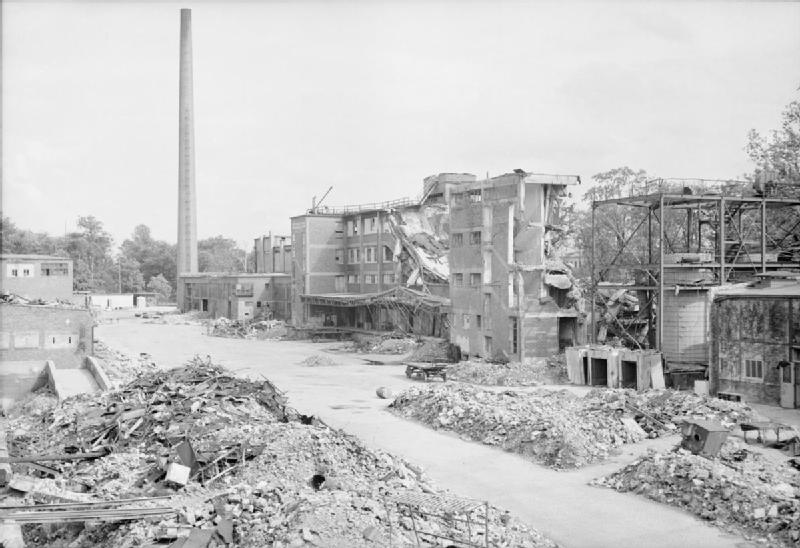
The photo with the blog post, is from Berlin in the year 1945, after side of the Allies won World War II in the European theatre.

Previously, I mentioned census data for Berlin, where it is listed, that at the end of 1944, the population was about 4.2 million, and at the end of 1945 about 3 million. And for 15th August 1945, it says about 2.8 million.

Now, if I would harbor ill will, and at that be running i.e. a video show on TV or wherever, these numbers might seem like a nice opportunity to create specific content with – of a type, that also is on the airwaves in different instances and context. As in:

“These are the official numbers! One point four million less of the population, after the Allies approached and entered Berlin. It must have been a slaughter! Just see the pictures – ruins everywhere and no flowers at all. Weren’t Nazis already defeated before 1945, with it taking Allies that long to reach Berlin, only because they were keeping playing golf along the way, and filling their trunks with whatever they got their hands on? Ladies and gentlemen, this is a scandal!”

In such a wording, there may be little to no complaint from the public. And after all: “I am merely a video content creator, looking for some clicks, and going with the flow of similar shows, where they keep going on and on, and don’t even have the faintest idea, of what they are talking about.”

But, what I did there, was at the very least, dishonest to truth. As in, using these numbers, to go to spin a story with just like that. It is dishonest, because like that, it is pretty much a fictional story, which uses a commonly known motive, even if the show and talk may have some resemblance to being like political etc.

In contrast to this example, stands academics. That is in such case, taking the time, to look at a number of things, starting in example wondering about how the census was counted. And there we may perhaps learn, that it was by a so-called “Meldeadresse”. Now we may wonder, whether that means, that it could be a possibility, that there actually weren’t 4.2 million people in the city already at the end of 1944? Perhaps many of the persons with a “Meldeadresse” in Berlin, happened to be Wehrmacht soldiers at some frontline somewhere, where Nazis once wanted to build their haciendas – and these soldiers, didn’t return to the city, such as due to being one of millions of fallen Wehrmacht soldiers, or after the hostilities ended, did become “internally displaced”? Are there some numbers about that? And perhaps, part of the city did flee, before or after the Allies entered the city? Hmm… so much to look at.

And actually taking the time, to look at this things, which may even involve going into non-virtual archives, that is generally called: research.

This research, I understand that it may not fit in, in today’s world of ever-accelarating news and media shows, with fierce competition, and “time is money”, and all that. I just think, that when it comes to professional topics, that it should be professional, and not pretending to be like some expert on whatever, while they are at best running a variety show of sorts, and at worst like Goebbels. And as far as my jurisprudence goes, at that worst, I consider it, where a type of malicious intent sits at, moreorless in cases. Meaning, that I do not consider it content appropriate to be broadcast by radio stations, TV stations, news outlets, and similar – pretty much just like there are restrictions i.e. in the United States, about vulgarities/curse-words not allowed to be broadcast.

Berlin and People

Berlin, the city known in the world perhaps mostly for being the place some guy from the Alps and his buddies happened to hang out at, for a period of time. And perhaps secondly known, for being the place, where part of the city area was part of the Western bloc, and part of the city area was part of the Eastern bloc, during the years of the so-called “Cold war”, with the “Berlin Wall”.

Historically, Berlin has been and is, a lot more than that, with a history spanning back centuries. By the mid-18th century, the population of what is now an inner city area, had grown to over 100,000, by 1880 it reached over a million, by 1919 nearly 2 millions – and once the surrounding area was incorporated into the city Berlin, in 1920 by the Greater Berlin Act of the Prussian state government, the population census for 31st December 1920 says 3,879,409.

There was a bit more growth after that, to around 4.3 million by 1929, with a similar number listed for the end of 1944, and then 3 million by the end of 1945. After that, the population of both city parts combined was at 3 to 3.4 million for decades, until about 2013, and then around 3.7 million by 2022 – that is according to census (with the caveats these things have, such as a change to the approach of how to count).

Besides just the numbers, there is naturally many a story in and with all that. Such as the stories about Huguenots, who were persecuted to death in France, and of who about 20,000 arrived and settled in and near Berlin by around the year of 1685. And many other such and other stories, not all of which were nor are about fleeing for life from the counter-reformation in a number of European countries back then.

These days, there are people from about 170 nationalities in Berlin. Some of these residents come as an attachment to an embassy, but many are here for private reasons, such as to work and/or study, or have arrived as refugee, or are in Berlin as “fortune seekers”.

If you were to happen to come by or live in Berlin, you might happen to sit in the Berlin underground (U-Bahn) next to one of around 100,000 citizen of Turkey, 55,000 of Poland, 40,000 of Syria, 31,000 of Italy, 30,000 of Bulgaria, 26,000 of Russia, 24,000 of Romania, 22,000 of USA, 20,000 of Serbia, 19,000 of France, 19,000 of Vietnam, 16,000 of UK, 14,000 of Spain, 14,000 of Greece, 14,000 of India, 14,000 of Croatia, 13,000 of Afghanistan, 13,000 of China, and so on – and a number of these are permanent residents. Like a Turkish citizen, born and raised in Berlin, speaking fluent German, perhaps even with an university degree – and as such, they are arguably even more local than e.g. a company representative from Bavaria, despite being a Turkish citizen, that is, a person who holds citizenship of Turkey.

Now, as many other cities on this planet, Berlin has its share of day-to-day business, such as traffic issues, and Berlin also has its particularities. One of these particularities is, being with the European Union. That does have nice aspects to it, but also has somewhat of an impact on a communal level, when the European Union at large doesn’t seem to care much about at least some baseline, in regard to social security in member states, nor about some rules in regard to evictions.

The result of which is that homeless EU-citizen arrived in Berlin from EU-countries, partially after evictions, and this is neither a great situation for these poor souls, nor for Berlin as city – and it would now get more political about stuff like that, to find a way together to improve these matters, instead of people getting treated just as numbers, who don’t matter when Mr “I made my money during privatization, and now also take money from EU, while bulldozing flats, that are within view of my golf course, while my buddy sits in government.” is around, or whatever else may be going far and wide in the European Union.

Soo… that’s about it, for an introduction about the place I am at, Berlin.